Council Services
Parish Climate Survey 2026
1. Introduction
The climate survey that was run this year is now concluded. Instead of withholding the survey data indefinitely pending the creation of a proper report, we are publishing the anonymous data raw for transparency and accessibility. The data is available for download at the end of this page, or can be accessed on google sheets here.
2. Design
Survey design was led by Lucy Roberts and Emi Roberts, with input and comment from the rest of the Twyford Climate Group and community members. Questions were designed to provide insight into areas of interest and maximise engagement, whilst answers were integrated climate psychology, research into similar questionnaires (demographic section design built upon CAA survey), and comments from the group and community. We used a combination of multiple selection questions, and free-form answers, as best suited the question. Though initially more questions had free-form responses, comments from the group and community indicated that this lack of structure made the questions very difficult to answer, which risked compromising form completion rate. Therefore, we changed many answers to be multiple selection – though pre-selected answers likely reduced the range of responses we received, for ease of data analysis and to boost survey completion rate we judged it preferable. We elected to run the survey primarily through google sheets for cost and ease of use, though made hard copies available from key locations across the village (surgery, shop, community centre, both pubs) to support inclusion of individuals with lower tech literacy to avoid sampling bias. The survey was anonymous to support openness and honesty from respondents. The survey will inherently be affected by self-selection bias as individuals already willing to engage with climate issues are more likely to fill out a climate survey than individuals who are ambivalent or hostile to climate issues. We decided to run the survey over a longer period of time to maximise the window for engagement, whilst leaning into urgency-based activations towards the end of the engagement window; we felt this approach was sort of ‘best of both worlds’.
The survey is intended to inform action across the village and support engagement. By gaining insight into what matters to people, what measures they have adopted/not adopted, what stops them from doing more, we can provide a data set which supports the identification of areas for improvement, and provides a framework for targeting key interests and concerns to boost engagement with climate/sustainability related activities, events and projects.
3. Active period of survey
The survey was open from mid-January to mid-July. The survey was advertised through several channels:
- Laminated posters pinned to message-boards and telephone poles across the village.
- Several companion articles and poster advertisements in the village newsletter.
- Several posts to village whatsapp (Twyford Information Group & Sustainable Twyford) and facebook groups from trusted accounts to improve trust of survey link and QR code.
- Physical presence at Colden Common Spring Greening event promoting survey completion with both digital and physical copies.
- Word-of-mouth promotion, led primarily by Cllr Sue Cook.
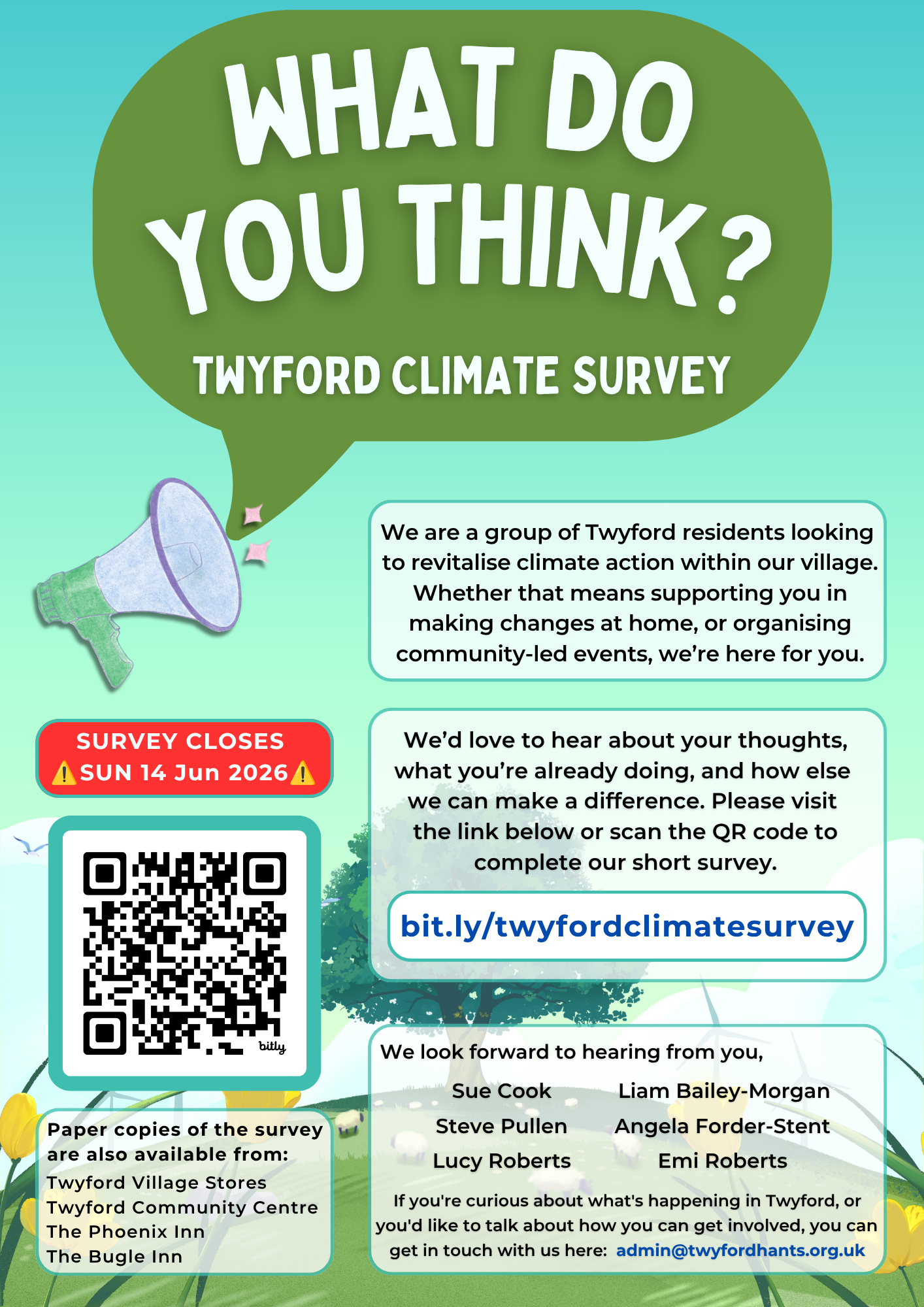
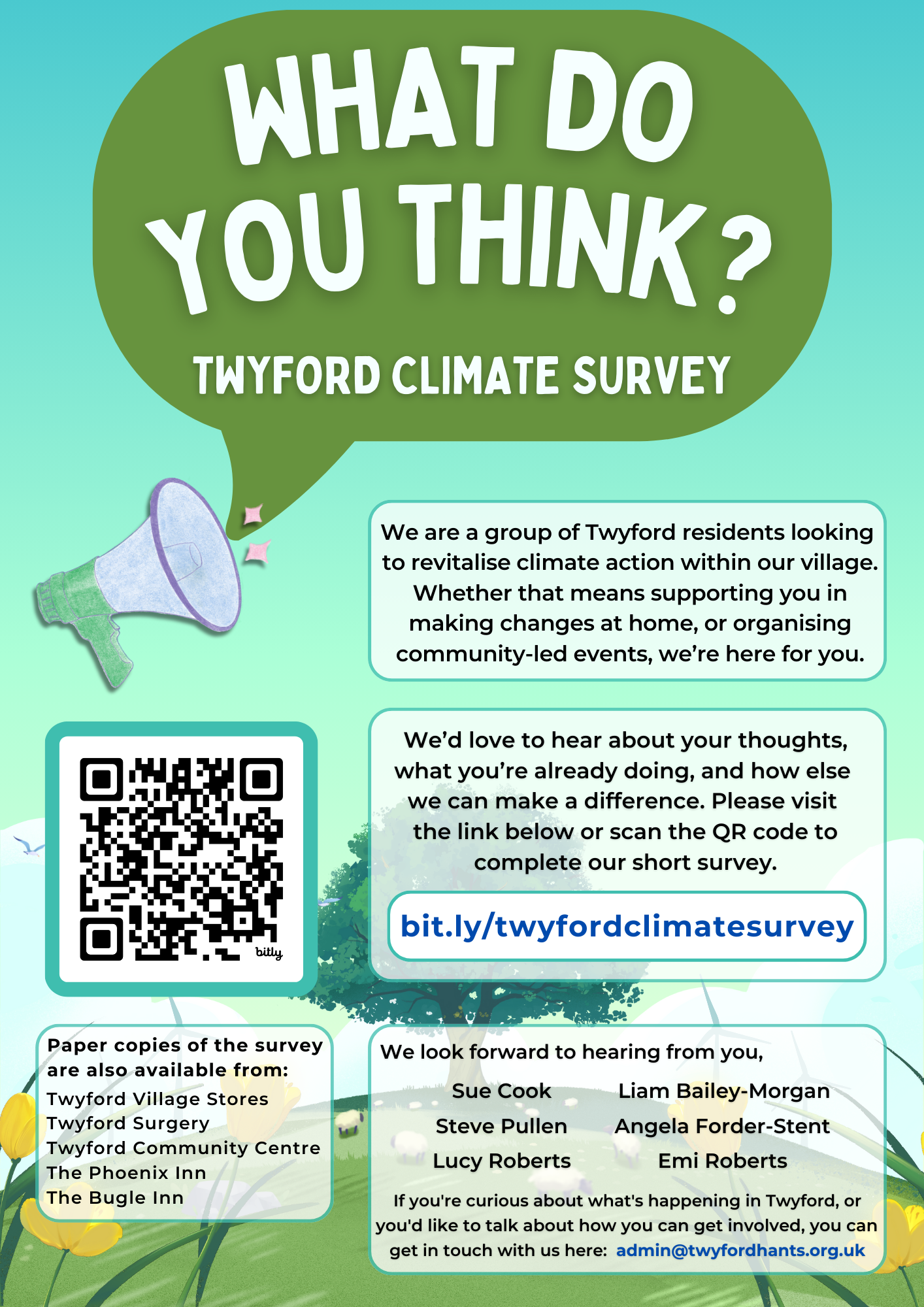
Channels used bit.ly links and qr codes to redirect to the google survey, and also all channels mentioned the locations of hard copies available around the village. A poster was produced to advertise the survey by adapting a template for free on Canva. Channels incorporated this poster where appropriate.
Towards the end of the active survey period, the poster was altered to emphasise the urgency, and was posted to village whatsapp groups with messages emphasising urgency (and a kind of ‘push’ for 100 responses). The poster and its variants will be included for download at the end of this page.
4. Post-survey insights
The mean response to question 2 (“how much do you think Twyford should focus on addressing climate change and its impacts”) on the survey was ~4.3; whether this indicates a high desire across the village for a focus on addressing climate change and its impacts, or is indicative of self-selection bias, is a question which would require further research.
The most common response to question 5 (“what holds you back from doing more?”) was “I don’t have enough time”. This indicates that in order to support climate action in the village, it would be important to make it as accessible and easy to engage with as possible, in order to reduce the time and energy required from participants. It may be worth considering how to meet residents where they’re at in order to minimise the time and effort required to engage. This may look like running talks or film screenings both face to face and online simultaneously, to allow time-pressured residents to join from home, or making resources easily findable and accessible online.
The most common response to question 6 (“I’d potentially be interested in…”) was “practical tasks or projects”. This indicates a high desire for direct action in the village – which is valuable for creating practical changes around the village aimed at climate mitigation and adaptation, and the fighting climate hopelessness/apathy by the feeling of pursuing and creating change with a strong community. In conjunction with question 5, this might indicate that respondents are willing to make time to ‘do more’ for fun and engaging events and projects targeted to their concerns or interests.
Question 7 was an unstructured response question which asked “What do you think we could do as a village to have the greatest impact on climate change?” As answers varied greatly, the data is not easily converted into charts, so this report identified common themes by visual analysis. Key themes among suggestions included:
- Reducing traffic and traffic speed through the village,
- Improving modes of travel alternative to cars with active travel routes, public transport connections to Winchester, and facilitating community ridesharing,
- Improving biodiversity through environmental conservation and restoration in both public and private areas (e.g. parks, gardens, verges),
- Providing residents with information and services with a focus on sustainability and climate transition to improve awareness and provide support in making changes and living sustainably (e.g. information and support on greener energy solutions, facilitating item reuse/swaps through online groups or events, improving local recycling services),
- Running projects and events in the community to support more sustainable lives and create more sustainable environments (e.g. repair cafe, skills swaps, conservation/restoration projects),
- Focusing on engaging in the community and including young people.
5. Conclusion
Hopefully the data collected will provide a firm foundation for further climate action and adaptation within the village by providing clear insights into the interests, attitudes, and concerns of residents, thereby providing guidance on how to maximise engagement.
Please remember that this whole project has been conducted by volunteers in their free time, so the work may contain minor errors – let us know if you sport anything amiss! If you have any questions or comments about this project, you can email us at admin@twyfordhants.org.uk
The survey data and posters are available for download below. Alternatively, the survey responses are available to view via google sheets here.